
5 Best Steps to Challenge a Speeding Ticket
Isn't it frustrating to receive a speeding ticket you believe is unjust? You can challenge it effectively by following a structured approach. Start by attending court ready to present your case, but that's just the beginning. From gathering evidence to questioning the speed measurement's accuracy, each step is essential. Are you prepared to navigate the complexities of traffic law and possibly secure a favorable outcome? Let's explore the best steps to take.
Key Takeaways
- Review the speeding ticket for details and gather evidence, including photographs and eyewitness statements, to support your case.
- Request disclosure of evidence from law enforcement and the court to access crucial documents like police reports.
- Challenge the accuracy of the speed measurement by investigating device calibration, officer training, and environmental factors that may have affected the reading.
- Document road conditions, signage, and weather at the time of the alleged violation to support your argument.
- Consider legal representation for complex cases to effectively navigate traffic laws and courtroom procedures.
Attend Court and Present Your Case
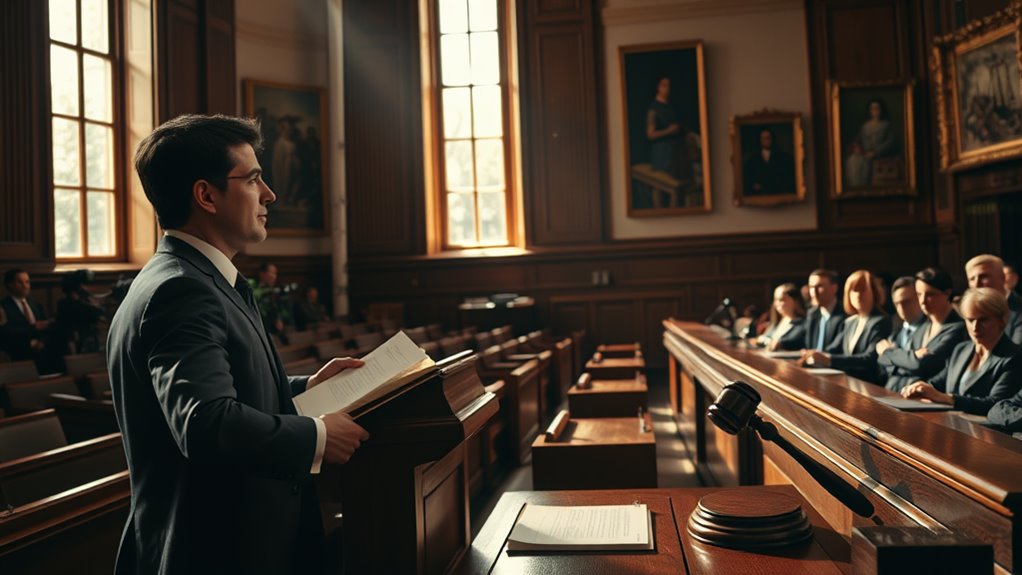
When you attend court to present your case, preparation is key. First, understand the violation by reviewing the ticket for vital details like the violation code and location.
Preparation is essential when attending court; start by reviewing your ticket for crucial details about the violation.
Gather evidence that supports your defense, such as eyewitness statements and photographs that counter the speeding claim. Consulting a traffic attorney can provide valuable insights into effective strategies and court procedures. Additionally, consulting an attorney can help identify the most effective types of evidence to bolster your defense. Having a traffic lawyer on your side can significantly improve your chances of a favorable outcome.
Familiarize yourself with court rules and etiquette; this shows respect for the judicial process. Organize your documentation systematically to guarantee a smooth presentation.
Present your evidence chronologically and maintain a respectful demeanor. Anticipate questions from the judge and deliver your defense confidently to strengthen your case and increase your chances of a favorable outcome.
Request Disclosure of Evidence
Requesting disclosure of evidence is an essential step in challenging a speeding ticket, as it allows you to gather important information that can bolster your defense.
Start by reviewing the charges and understanding your jurisdiction's discovery process. Make clear, specific requests for crucial evidence, such as police reports, calibration records, and dashcam footage.
Direct your requests to the relevant law enforcement agency, prosecutor's office, and court clerk, ensuring you obtain proof of service. If you don't receive a timely response, consider sending a follow-up request or filing a motion to compel discovery.
Gather Supporting Documentation
Gathering supporting documentation is crucial in building a solid defense against a speeding ticket. Start by capturing photographs of the scene, focusing on road conditions, signage clarity, and any obstructions blocking speed limits.
Documenting the weather can also substantiate how visibility may have impacted your driving. Additionally, keep records of your vehicle's maintenance to prove it was in good condition.
Look for road hazards or conditions that required you to adjust your speed. Witness statements can bolster your case; verify they address visibility and conditions at the time.
Finally, verify the legitimacy of speed limit signs, checking for clarity and compliance with regulations. This thorough evidence strengthens your argument and can potentially sway the outcome in your favor.
Challenge the Speed Measurement Accuracy

Challenging the accuracy of speed measurement can greatly bolster your defense against a speeding ticket.
Begin by scrutinizing the calibration and maintenance of the device used to measure your speed. If you discover that the device wasn't properly calibrated or maintained, it undermines the validity of the reading.
Scrutinizing the device's calibration and maintenance can significantly weaken the validity of your speeding ticket.
Additionally, investigate the officer's proficiency in operating the device; an inexperienced operator may produce inaccurate results.
Consider the possibility of operator error, especially in busy traffic, where the device might mistakenly target another vehicle.
Finally, assess environmental factors—poor visibility or bad weather can considerably impact accuracy.
Consider Legal Representation for Complex Cases
After examining the speed measurement's accuracy, it's wise to contemplate the complexities of legal representation, especially if your case involves significant consequences.
Traffic laws differ widely by jurisdiction, and a knowledgeable attorney can navigate these complexities for you. They'll analyze evidence, including officer testimonies and dashcam footage, to build a robust defense tailored to your situation.
Legal experts identify procedural errors that could benefit your case and help mitigate long-term implications like insurance rate increases. With their courtroom experience, attorneys negotiate effectively with prosecutors, potentially reducing charges or penalties.
Conclusion
Challenging a speeding ticket might seem intimidating, but with the right approach, you can effectively present your case. Remember, it's not just about the speed; it's about the details. By gathering evidence, questioning the speed measurement, and knowing your rights, you stand a better chance of success. And if it gets complicated, don't hesitate to seek legal help. After all, every driver deserves a fair chance to defend themselves against inaccuracies and errors.